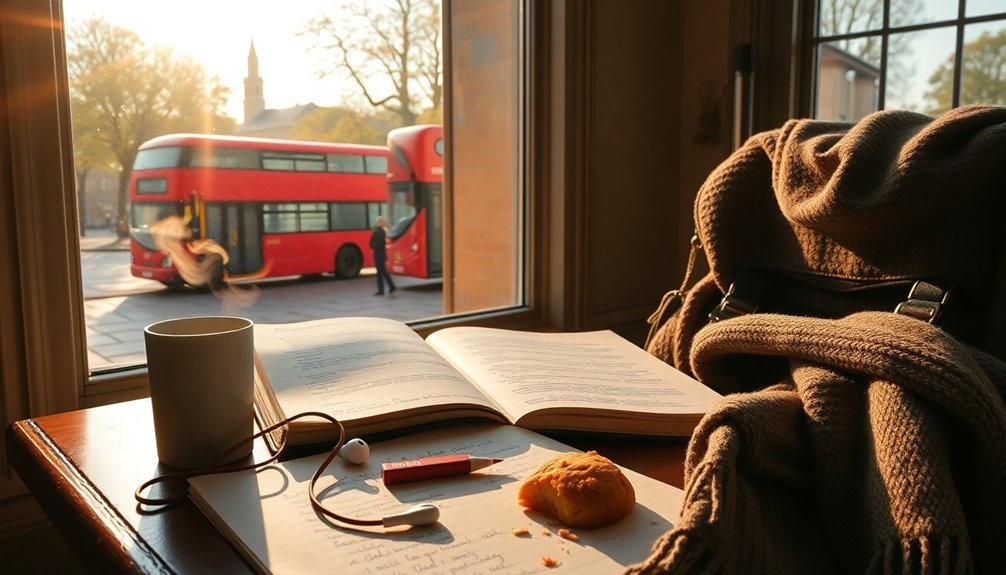
A Day in the Life of an English Student in Dublin
Study English In Ireland
December 3, 2025

You wander Dublin like a close reader, tracing Georgian facades and cobbled clues en route to seminars, trams and buses marking your cadence. You map bakeries, benches and bus stops, learning tap-in rules and safe bike lanes. On campus you mine accents, debate in cosy cafés and practise pronunciation in quiet corners. Evenings bring readings, themed socials and festivals that sharpen your idiom. Keep going and you’ll find practical routes, budgets and spots that sustain this daily inquiry.
Although the morning streets of Dublin can feel quietly ordinary, they reveal layers of history and habit if you look closely: cobbled lanes, Georgian facades, and corner cafés map social rhythms as surely as any transit line. You’ll find neighborhood exploration becomes a deliberate practice: note the sequence of façades, the habitual bench where an elder reads, the bakery window that signals morning’s arc. Treat local landmarks as orienting texts—church spires, commemorative plaques, an inconspicuous bridge—each offers predictable cues that make movement safe and intelligible. You’ll develop a calibrated attention: routes that feel sheltered, lighting that reassures, streets where footfall implies community presence. Keep to well-used passages, time your walks to daylight hours at first, and learn the faces behind service counters; familiarity mitigates uncertainty. In that attentive cadence, Dublin’s ordinary fabric becomes a studied map, letting you move with confidence while absorbing the city’s layered narratives.
One practical rule you’ll learn quickly is to treat Dublin’s transport as a layered text — buses, trams, bikes, and the occasional ferry each have their own grammar and register — so read timetables and routes the way you’d annotate a poem: for cadence, repetition, and unexpected enjambments. You’ll parse the city’s public transport map like a prosody, noting peak rhythms and safe crossings. Choose reliable routes, allow buffer time, and keep a charged phone with route apps; safety isn’t rhetoric, it’s procedure. If you cycle, prefer designated lanes and vetted bike rentals with good lights and locks; helmet and visibility gear are pragmatic allusions to caution. Learn tap-in rules for trams and buses, memorise a couple of fallback stops, and avoid late solo detours. The practiced commuter balances efficiency with precaution: consult live updates, trust municipal signage, and cultivate a calm punctuality that turns travel into a study of urban order rather than a gamble.
When you step onto campus, you’ll find the quad is less a mere gathering place than a live seminar in sociolinguistics: conversations ricochet between accents, registers, and code-switches, offering constant, low-stakes practice for listening and speaking. You’ll notice curated opportunities—weekly language exchange meetups, peer tutoring hubs, and theatre workshops—that let you rehearse idiom and intonation in contexts that feel safe and scaffolded. Campus societies stage readings and debates where feedback is collegial, so you can experiment without exposure anxiety. Libraries and study centres host conversation corners and multimedia labs, so you can compare phonologies and practice pronunciation privately before trying public speech. Faculty-run film nights and guest lectures supply comparative frames for cultural immersion, linking language to literature, history, and everyday life. You’ll move between structured drills and incidental interactions, learning to calibrate voice and register while staying within a supportive network that values gradual risk-taking and steady progress.
Conversations don’t stop at the quad’s edge; they carry on into cafés and canteens where vocabulary meets value and accent blends with aroma. You learn quickly that affordable sustenance isn’t merely caloric—it frames your day and your comfort. Seek out budget bites that are honest in provenance: a toasted panini, a soup pot simmering with seasonal root vegetables, a bakery’s brown soda bread. They’ll anchor study marathons without financial strain.
Cozy cafes double as informal classrooms; their guarded familiarity and predictable menus create a quiet safety net. You can eavesdrop on idioms, exchange readings, or refine pronunciation over a modest flat white. Map routes between lecture halls and these havens so rain or late evenings don’t unsettle you. Be discerning about hygiene and opening hours; prefer spots with clear policies and visible staff. In Dublin, thrift and warmth coexist — you just have to know where to go and how to move between them deliberately.
While the afternoon light slants through mullioned windows and you settle with a notebook, structure becomes your ally: schedule focused sprints—forty-five minutes reading, fifteen minutes annotation—so dense texts don’t overwhelm the mind’s bandwidth. You calibrate study techniques to the text: close reading for poetry, thematic mapping for novels, quotation harvesting for essays. You pick library resources with care—special collections for marginalia, electronic databases for critical theory—so every source feels reliable and safe. You annotate in ink, but keep a digital backup; you cross-reference catalogues, noting shelf marks as if mapping a tiny, private atlas. You favor quieter rooms where footsteps are measured and policies are clear; that predictability protects concentration. Between sprints you let associative thought surface, then tether it back to thesis. The routine isn’t ritualistic indulgence but a disciplined practice that balances curiosity and restraint, helping you produce work that’s rigorous, evidence-based, and calmly confident.

Although the day’s solitary rigor prepares your arguments, evening socials recalibrate the student mind into a different, necessary mode: pubs and seminar-reception rooms become laboratories for testing ideas in abbreviated, performative forms, where wit and listening are research methods in their own right. You’ll find gentle structures—reading groups, campus societies, themed events—that let you experiment without exposure, offering predictable cues and clear consent cultures. Conversations move between close reading and anecdote; you’ll practice concise pitches, notice how humour dissolves tension, and learn to steer debates toward curiosity rather than confrontation. These gatherings also provide quiet networking opportunities: mentors linger, peers circulate, and collaborations begin with a shared joke or citation. You’ll leave with annotated notes, follow-up messages, and the confidence that intellectual risk can be contained and repaired. In Dublin’s convivial rooms, sociability is pedagogical: safety and rigor coexist, and your scholarly persona is honed through humane, deliberate encounter.
After nights spent sharpening arguments over pints and polished conference hors d’oeuvres, you’ll need practical arrangements that let those intellectual experiments persist: budgeting, banking, and phone plans shape how you can attend events, follow up with contacts, and sustain the routines of study. You’ll want a basic checking account with low fees, accessible online banking, and clear overdraft protections so small mistakes don’t become crises. Explore student discounts for transport, museums, and subscriptions; they compound into real breathing room. Use budgeting apps to map rent, groceries, and occasional academic outings, and set categorical limits that feel conservative rather than punitive. For mobile, pick a reliable prepaid or student-plan MVNO with generous data and EU roaming if you’ll travel; test coverage near your college and accommodation. Keep essential documents backed up and share emergency contacts with a housemate. These modest, deliberate systems let you pursue literary work with the assurance that practicalities are under control.
When you step off the tram or train at a mist-softened station, Dublin unfolds as a compact curriculum: galleries, literary haunts, and coastal walks that each teach a different lesson in the city’s moods and histories. You’ll plan weekend excursions with the same attentive care you bring to seminar prep, prioritizing safe, well-timed routes and reputable guides. Start with the National Gallery and the intimate house-museums of Yeats and Joyce, then trace the spine of the city to historic landmarks like Trinity and Dublin Castle, reading stones and plaques as secondary texts. Reserve evenings for cultural festivals that condense civic identity into concentrated performances—music, spoken-word, theater—where you’ll observe contemporary dialogue and communal habits. For coastal clarity, choose supervised cliff walks or ferry crossings with clear timetables; they offer restorative perspective without needless risk. Each excursion doubles as fieldwork: you’ll collect impressions, annotate maps, and return to campus with disciplined notes and a quieter confidence in your urban literacy.
Yes — you might need a visa, depending on your nationality and the course length. You’ll assess student visa requirements and short course eligibility carefully: many countries exempt stays under 90 days, but others require a study visa even for brief programs. You’ll want authoritative guidance from the embassy or school, document proof of enrollment, funds, and accommodation, and guarantee compliance to preserve safety, legal status, and uninterrupted study.
Can you realistically bring a car or motorbike to Dublin as a student? Yes — but you’ll need to navigate car parking limits and strict insurance requirements; you’ll also face import rules, vehicle tax, and NCT inspections. You should secure thorough insurance, familiarise yourself with parking permits and city restrictions, and plan for higher costs and tighter safety standards. Treat transport choices as risk-managed decisions to keep yourself and others protected.
Yes — part-time remote work options exist for international students, though availability varies. You’ll find remote job opportunities in tutoring, content, and admin roles that let you preserve study time and protect work life balance. You’ll need to check visa rules and employer credibility; lean on university career services and vetted platforms. With prudent choices, you can earn safely, maintain routine, and avoid overcommitment while keeping academic priorities intact.
Yes — you’ll generally access care but shouldn’t assume full free coverage. Investigating this truth shows a layered system: you’ll need health insurance and may use public or private medical facilities depending on your registration and insurer. You’ll register with a GP, access student health services, and use hospitals for emergencies; supplementary private plans speed things up. Be meticulous with policy limits, prescriptions and referral rules to guarantee secure, prompt treatment.
You register to vote only if you meet voting eligibility — usually Irish or qualifying EU/UK citizens for local and European polls; non-EU students generally can’t vote in national elections. For residency paperwork, satisfy residency requirements by registering with immigration (GNIB/IRP), keeping proof of address, enrollment, and financial means. You’ll want certified documents, timely renewals, and to consult official sources so your legal status stays secure and predictable.
You leave Dublin at dusk like a book you’ve dog‑eared to remember the best lines: streets that teach, classrooms that forge voice, cafés that keep secrets. You’ll map your days with thrift and curiosity, turning transit minutes into grammar drills and library stacks into quiet altars. Each conversation is a tide drawing you toward fluency; each weekend a fresco of history. You go on, knowing the city will keep shaping the sentence of you.